Intersociety Summer Conference Reflections
ACR 2026 Intersociety Summer Conference is an annual event aimed at fostering communication and interchange among the national radiological societies.
Read moreEvery summer, leaders from across the medical imaging spectrum gather for the Intersociety Summer Conference to step back from our daily reading room routines, exchange honest perspectives and map out the trajectory of our profession.
In July 2026, representatives from 26 distinct radiologic organizations gathered in Minneapolis for a meeting focused on a prompt that hits close to home for every organization in our field: "Building a Robust Future for Radiology Professional Societies."
While the agenda covered a wide range of forward-looking ideas, one central topic dominated our conversations throughout the week: Member retention, with a deliberate emphasis on radiologists transitioning out of training to become new attendings.
That moment — moving from residency or fellowship into early staff practice — is one of the most intense periods in a radiologist’s professional life. As schedules fill up, board exams recede into memory and clinical responsibilities scale up, maintaining active ties to professional organizations often slips down the priority list.
Addressing this critical drop-off point required having the right stakeholders at the table. Our meeting brought together leadership and representatives from across organized radiology, including the ACR® Resident and Fellow Section, the American Board of Radiology, the Radiological Society of North America, the Society of Skeletal Radiology, the American Roentgen Ray Society and the Society for Imaging Informatics in Medicine, among many others.
To frame our discussions, we welcomed keynote speaker Joanna Pineda from the Matrix Group, who provided an eye-opening perspective on membership dynamics. Her overarching message was both reassuring and challenging: The membership hurdles facing radiology are not unique to our specialty. Professional associations across healthcare, technology, engineering and education are grappling with identical retention trends.
Rather than viewing this as a discouragement, she urged us to see it as an opportunity for cross-society collaboration. Instead of operating in isolated silos or competing for the finite attention of young physicians, societies can achieve far greater impact by leveraging their innate individual strengths to build synergistic partnerships.
Joanna offered several actionable insights on how professional societies can cultivate long-term engagement among both new and seasoned members. Her primary takeaway centered on the irreplaceable power of genuine human connection. In an era dominated by virtual webinars, automated emails and digital portals, personal relationships remain the ultimate anchor for member loyalty.
She emphasized that national conferences and annual meetings must actively foster an inclusive, warm environment. Trainees and early-career attendings should never experience the feeling of wandering through a massive convention center completely by themselves.
Society leaders must make intentional efforts to initiate direct, personal conversations with newer members, ensuring they feel welcomed, recognized and genuinely valued. When a new attending realizes that senior leaders care about their voice and career development, their relationship with that society shifts from a transactional subscription into a meaningful professional home.
Creating these lasting connections requires providing real value at every career stage. For early-career radiologists navigating the complex transition to clinical practice, leadership development and business education are essential bridges.
Programs such as the ACR Radiology Leadership Institute® give new attendings the operational tools, negotiation insights and executive strategies needed to thrive in modern practice environments.
Similarly, active involvement in groups like the ACR Resident and Fellow Section gives trainees a seat at the decision-making table long before they complete their formal education. When societies invest early in a radiologist's career trajectory, those physicians are far more likely to stay engaged as active, lifelong leaders.
Beyond internal practice models, our discussions highlighted a vital external driver for society participation: The swift rise of AI in medical imaging. As AI algorithms proliferate across clinical practice, professional societies play an essential, irreplaceable role in shaping how this technology is evaluated, deployed and regulated.
Left unchecked, oversimplified narratives surrounding AI risk misinforming the public and policy makers alike. Active membership gives radiologists a collective voice to ensure that regulatory frameworks prioritize patient safety, data quality and clinical efficacy over hyperbole. Through initiatives like the ACR Data Science Institute®, organized radiology provides the evidence-based guidance and oversight needed to integrate AI safely into everyday workflows.
Equally critical is our responsibility to help lawmakers and health policy leaders understand the true scope of our specialty. To those outside the reading room, radiology can sometimes be misconstrued as a mere image-interpretation service — a narrow view that makes it easy to overestimate what AI can accomplish independently.
Professional societies serve as our primary advocacy arm to educate legislators on the full breadth and depth of a radiologist's role. We are diagnostic experts, proceduralists, multidisciplinary consultants and quality directors who synthesize complex clinical context to guide patient care.
Robust membership participation directly fuels advocacy efforts like those driven by ACR Government Relations, ensuring that regulators recognize medical imaging not as a series of isolated algorithms, but as a deeply human, physician-led discipline essential to modern healthcare.
Of course, some of the most memorable moments of connection happen outside the formal conference session rooms. One evening during our time in Minneapolis, attendees enjoyed a relaxed night out at Target Field to watch a Minnesota Twins baseball game.
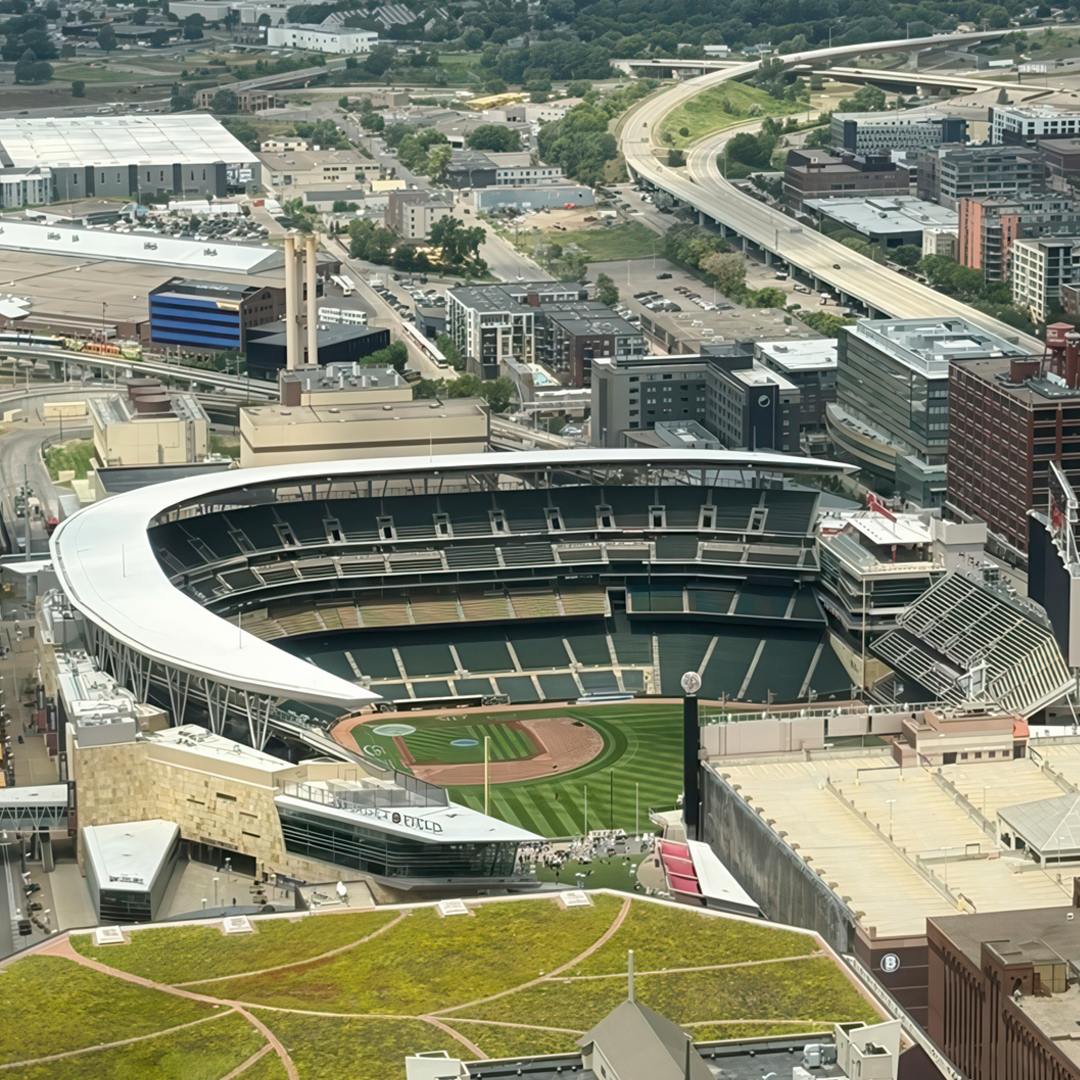
View of the Minneapolis Twins baseball stadium.
Organized through the ACR, this social gathering gave everyone a chance to unwind together, share stories and talk shop over ballpark food. Sitting in the stands on a warm July evening perfectly encapsulated Joanna Pineda’s advice: Beneath all the committee structures and strategic plans, professional societies thrive when people simply connect with one another as colleagues and friends.
As we wrapped up our time in Minneapolis, the consensus across all 26 societies was clear. The future of organized radiology depends on our willingness to work together, break down traditional organizational silos and focus relentlessly on supporting our newest attendings.
By creating welcoming meeting environments, offering high-value professional development, amplifying our collective voice on emerging technologies like AI and fostering authentic human connections, we can ensure that every radiologist finds a lasting, supportive home in our professional community for years to come.
Intersociety Summer Conference Reflections
ACR 2026 Intersociety Summer Conference is an annual event aimed at fostering communication and interchange among the national radiological societies.
Read moreNIH Promotes New Website
NIH launched a new topic-based website experience to simplify access to research resources, funding opportunities and health information.
Read moreACR Responds to Senate Finance RFI on Healthcare Reform
ACR responded to a Senate Finance RFI, advocating for imaging reforms that support timely care, physician judgment, and lower costs.
Read more